Last updated October 31, 2026
 Smart locks
 House lockouts
 Re-keying
 Deadbolt upgrades
 Schlage
 Kwikset
 Car keys & fobs
Non-destructive entry first, always - and we re-key Schlage, Kwikset, and Baldwin locks on the spot while you watch
You get a price before we start. It does not change when we arrive. No surprises.
Get your free estimateDIY vs Professional Locksmith: The Lansing Homeowner’s Decision Guide
Kwikset SmartKey cylinders are marketed as the homeowner-friendly rekeying solution, and they are, but they are also the single most common lock we see carried into a Lansing locksmith shop after a DIY attempt left the plug binding. The tool costs twelve dollars. The replacement cylinder costs six times that, plus labor. This guide draws the line not at homeowner confidence but at hardware tolerance. You will learn which three tasks are genuinely safe to do yourself, where the failure modes hide on popular lock brands, what a botched job actually costs in Lansing, and when picking up the phone at (866) 361-1189 saves you money before the first screw is turned. For locksmith emergency preparedness tips for Lansing homes, see our dedicated guide.
Styles & brands we work with
Quick Answer
Most homeowners in Lansing can safely handle three locksmith-adjacent tasks: strike plate reinforcement, hinge tightening, and smart lock battery replacement. Rekeying a Kwikset SmartKey cylinder is DIY-viable but unforgiving if the sequence breaks. Everything else involving a Medeco, Abloy, Mul-T-Lock, or an out-of-square deadbolt is cheaper to hire out from the start because the failure cost exceeds the professional service cost.
Table of Contents
- What’s Genuinely Safe to DIY
- The Kwikset SmartKey Rekeying Reality
- Tasks That Seem Simple but Aren’t
- High-Security Cylinders: The Warranty Line
- The Lansing Rental Property Angle
- The Cost-Risk Matrix: Where DIY Saves Nothing
- How Homeowners Damage Hardware
- Common Mistakes to Avoid
- When to Call a Professional
- Frequently Asked Questions
- The Bottom Line
What’s Genuinely Safe to DIY
Three tasks deserve a green light for the average Lansing homeowner. None of them involve taking a lock cylinder apart, and none of them can render your door inoperable if done wrong. They are deadbolt strike plate reinforcement, door hinge tightening, and smart lock battery replacement. These tasks require a screwdriver, maybe a drill, and about thirty minutes of attention. The cost of failure is zero to marginal, and the payoff in security and door function is immediate.
Deadbolt strike plate reinforcement is the highest-value thirty-dollar security upgrade you can make. The strike plate is the metal plate screwed into the door frame where the deadbolt bolt seats. In many Lansing homes built before 1990, that plate is attached with half-inch screws that only bite into the door jamb trim. A firm shoulder push can split it. Replacing those screws with three-inch hardened screws that reach the wall stud behind the jamb is a ten-minute job. If the plate itself is bent, you can buy a heavier replacement strike plate at any hardware store in the Lansing area for under twenty dollars. There is no rekey risk, no cylinder disassembly, and no way to lock yourself out.
Door hinge tightening solves the most common cause of a deadbolt that scrapes or a latch that misses the strike plate. Seasonal humidity swings in mid-Michigan cause wood door frames to swell and contract. Hinges loosen, the door sags a few degrees, and suddenly the deadbolt does not align. Tightening hinge screws is entirely within homeowner reach. A screwdriver, a few minutes per hinge, and the door sits true again. If the screw holes are stripped, a toothpick-and-wood-glue fill or a longer screw fixes it. This is the task we most often see homeowners do correctly without help.
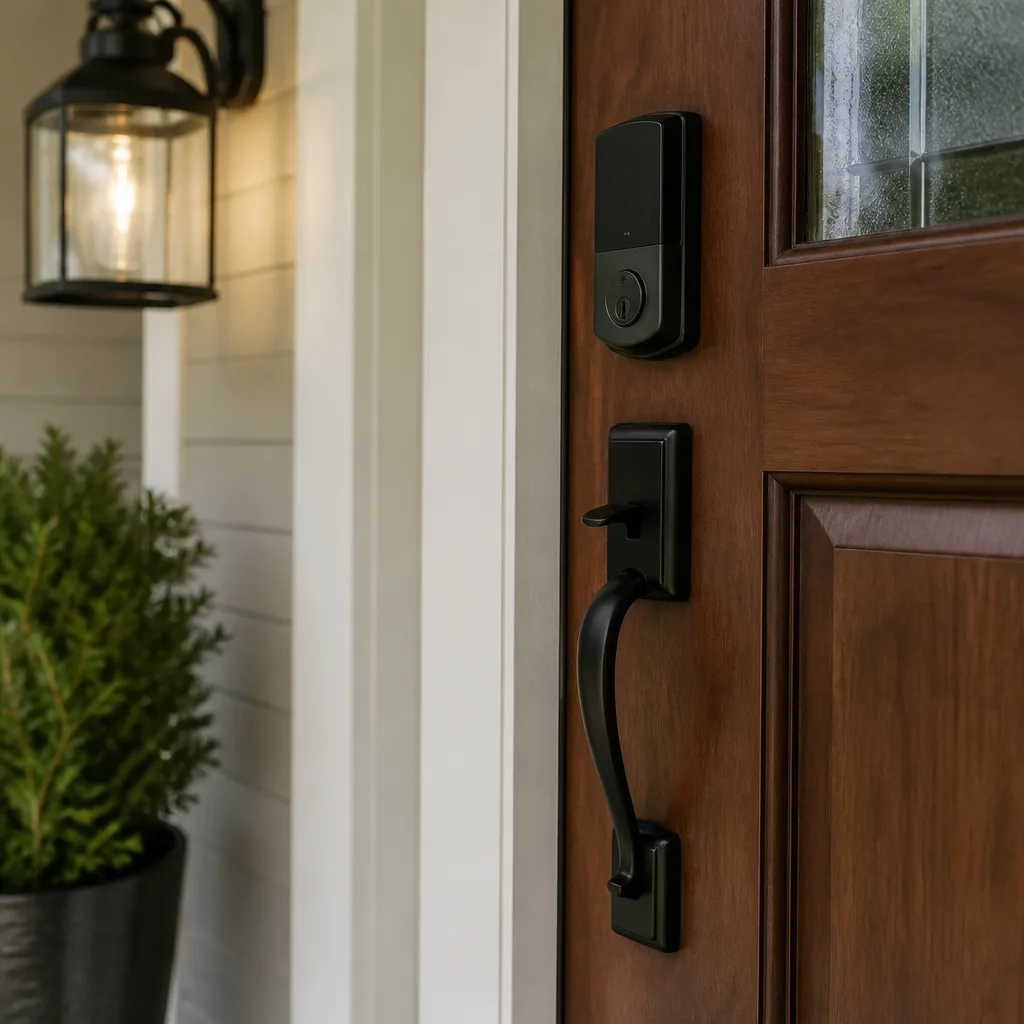
Smart lock battery replacement is the third safe DIY task. Every smart lock manufacturer builds this as a user service item. On a Schlage Encode or a Yale Assure, the battery pack pulls out from the interior escutcheon without touching the cylinder or keyway. Replace the four AA batteries every six months, keep a physical key in a known location as backup, and you will never need a locksmith for this. The only failure mode is leaving old alkaline batteries in place long enough that they corrode. Even then, the fix is usually cleaning the contacts, not replacing the lock.
These three tasks share a trait: they are externally accessible, they do not require opening the lock mechanism, and a mistake does not strand you outside. That is the threshold. Cross it, and the risk profile changes.
The Kwikset SmartKey Rekeying Reality
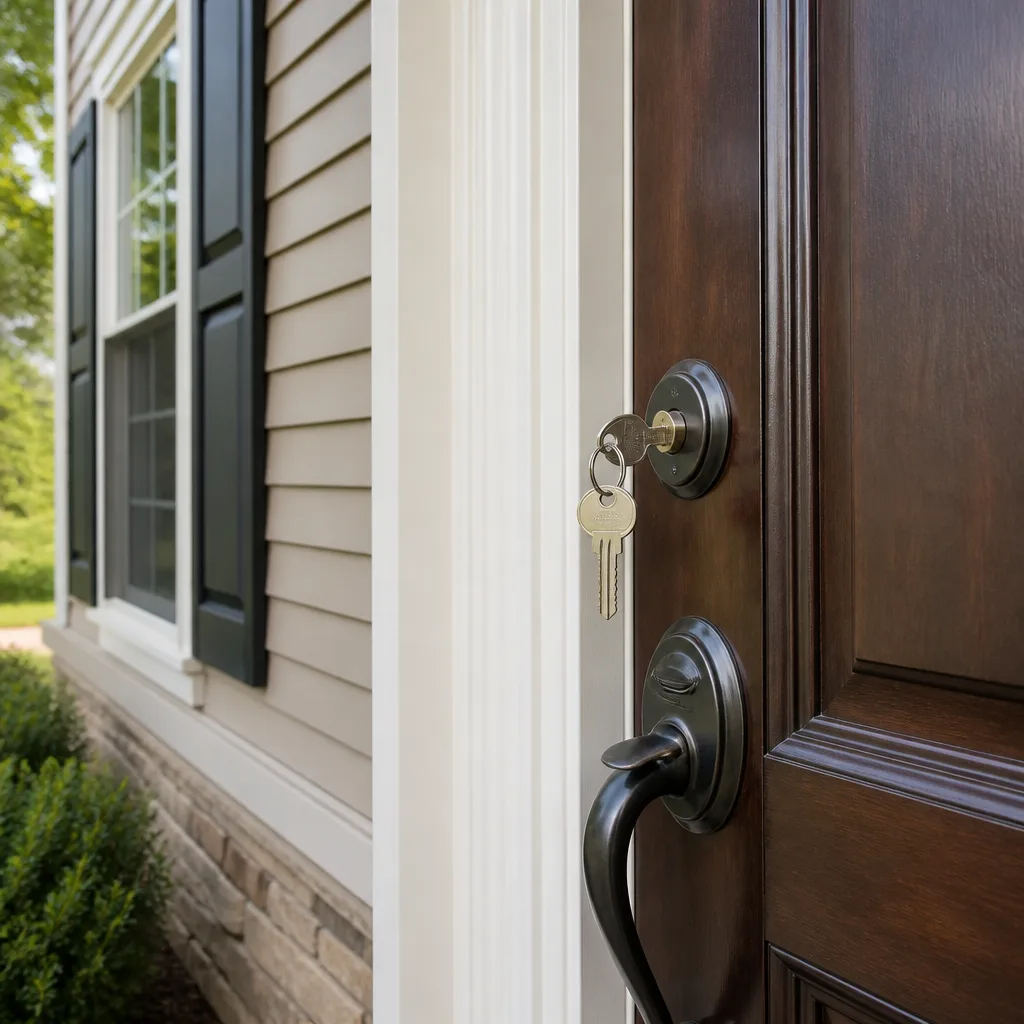
Kwikset SmartKey cylinders are the most common rekeyable-by-the-owner lock on the market, and Lansing homes have thousands of them. The SmartKey system uses a learning tool that lets you rekey the lock to a new key in about thirty seconds without removing the cylinder from the door. The marketing is accurate. The mechanism is less forgiving than the marketing suggests.
Here is the sequence, because the sequence is the entire point:
- Insert the current working key and turn it a quarter turn clockwise to position the cylinder in the rekeying orientation.
- Insert the SmartKey learn tool into the small hole beside the keyway until it seats.
- Remove the tool. Remove the current key.
- Insert the new key and turn it a half turn counterclockwise, then back to the original position.
- Remove the new key and test it three times before closing the door.
The failure mode happens at step two and step four. If the tool is inserted with too much force, or if the new key is turned before the tool is fully removed, the internal wafers lose their indexing. The result is a cylinder that no longer responds to either the old key or the new one. The lock is now in a state that a homeowner cannot reverse. We have seen this exact failure on kitchen doors, front doors, and back doors across Lansing neighborhoods from Old Town to Groesbeck. The customer usually arrives at our shop with the lock in a ziplock bag and a new deadbolt already in hand from the hardware store. The fix is a replacement cylinder or a full replacement lock, and the bill lands between ninety and one hundred forty dollars for a lock they already owned. For a detailed locksmith cost breakdown for Lansing homeowners in 2026, see our pricing reference.
SmartKey rekeying is DIY-viable. It genuinely is. But the tolerance between a clean rekey and a dead cylinder is narrower than the instruction sheet implies. If you are going to do it, do it slowly. Test the new key six times before you allow the door to close. And know that if the cylinder binds, the cost crosses the professional rekey cost within about three failed attempts. Our rekey service in the Lansing area handles SmartKey cylinders for a flat rate that usually costs less than the replacement lock you will buy after a failed attempt. Rekey, don’t replace, and if you do want to try it yourself, understand what binding feels like: the tool will not seat cleanly, the key will feel gritty, and the first test will fail. That is the moment to stop.
Tasks That Seem Simple but Aren’t
Three jobs masquerade as beginner work and eat more DIY weekends than anything else we see in Lansing. The tools are common. The failure modes are not.
Deadbolt alignment on an out-of-square door. A deadbolt that scrapes the strike plate seems like a ten-minute fix. The homeowner installs a file and opens the plate hole wider, or they shim the hinge. The real problem on many Lansing doors is that the door itself is out of square, or the frame has settled. Opening the strike plate hole wider fixes the scraping symptom while leaving the security flaw: a deadbolt that does not seat fully past the plate is a deadbolt that can be jimmied. The proper fix involves planing the door edge, mortising the hinge deeper, or installing an adjustable strike plate and realigning the entire frame. Each of those requires a level of door-fitting skill that most homeowners do not have, and a mistake means you are re-hanging the door. A professional alignment in Lansing costs less than the replacement door slab you will eventually need if the fix goes wrong.
Smart lock installation on a door without existing prep. This is the trap. A smart lock arrives in a box and the instructions assume a standard pre-drilled door with a 2-1/8-inch cross bore and a 1-inch edge bore. Many Lansing homes with original solid wood doors do not have that prep. Boring a cross bore through a solid oak door with a hole saw, without a jig, freehand, while keeping the bore square to the door face, is a job that professional locksmiths treat with respect. A crooked bore means the smart lock sits cocked, the deadbolt binds, and the motor burns out prematurely. We have replaced smart locks on Lansing doors where the homeowner’s freehand bore wandered three degrees off square and the lock motor failed within a year. The cost of the replacement lock plus professional prep exceeded the cost of hiring a locksmith for the initial install by about one hundred eighty dollars.
Anything involving a mortise lock. Older Lansing homes near the Capitol and in the Westside neighborhood still have original mortise locks. These are not Kwikset cylinders in a bored hole. A mortise lock is a cast body that slides into a mortised pocket in the door edge, with the spring mechanism inside the body. Disassembling one requires understanding the spring stack, the deadbolt timing, and the handed lever orientation. Put it back together wrong and the door locks but will not unlock from the outside, or the deadbolt extends while the latch is retracted and the door jams. We have seen every variation. This is professional-only work, not because the mechanism is secret but because the parts are no longer manufactured and a mistake destroys a lock that cannot be replaced from stock at any Lansing hardware store.
High-Security Cylinders: The Warranty Line
Medeco, Abloy, and Mul-T-Lock cylinders sit at the top of the residential and commercial lock market, and in Lansing they appear on a surprising number of side doors, garage entries, and small business storefronts. These locks have one thing in common: the manufacturer warranty is voided the moment an owner opens the cylinder without factory authorization. That is not a scare tactic. It is printed in the documentation.
A Medeco cylinder uses a different key control system than any Kwikset or Schlage product. The keys are patented and cut on restricted blanks. When a Medeco cylinder is disassembled by an untrained hand, the driver pins and sidebar sliders fall out of alignment, and reassembling them requires a pinning chart and a specialized follower. The same applies to Abloy’s disc-detainer mechanism and Mul-T-Lock’s telescoping pins. These are not locks you rekey with a fifteen-dollar kit from a store shelf. The kits do not exist for retail sale. The key blanks are restricted. The internal parts are not sold to consumers.
From Schlage to Medeco, we know your lock. And when a Medeco cylinder comes to us after an owner attempt, the repair bill is not a rekey fee. It is a full cylinder rebuild, often with parts ordered from the manufacturer, and sometimes a replacement cylinder if the damage is severe. The crossover math is straightforward: a professional rekey of a high-security cylinder costs between forty and ninety dollars in the Lansing market. The replacement cylinder alone runs one hundred twenty to two hundred dollars, before labor. High-security hardware, handled right, costs less than high-security hardware, handled twice.
If your Lansing home or business has Mul-T-Lock, Abloy, or Medeco hardware, the DIY question is not about skill. It is about warranty. The manufacturer will not cover a cylinder that has been opened by anyone other than a certified technician. And the failure state of these locks, unlike a Kwikset, is a lock that will not operate at all, not a lock that rekeys sloppily.
The Lansing Rental Property Angle
Rental property owners in Lansing, particularly around the Eastside and the student-heavy rental corridors near Michigan State University, have a specific rekeying cadence. Tenants turn over every twelve months, sometimes more frequently. The instinct is to handle rekeying in-house to save the per-door fee. For a landlord with six units and two doors per unit, rekeying twice a year, the DIY savings looks real on paper. The liability exposure rarely does.
Here is the scenario. A landlord rekeys a SmartKey cylinder between tenants and does the sequence slightly wrong. The lock appears to work during the walkthrough. Three weeks later, the cylinder starts binding. The new tenant gets locked out on a winter night in Lansing when temperatures are in the teens. The landlord is out of town. The tenant calls a locksmith at 9 p.m., pays a one hundred fifty dollar emergency fee, deducts it from rent, and files a complaint. The landlord now owns a damaged lock, an upset tenant, and a rent deduction that exceeds the cost of professional rekeying for the entire unit.
The documentation angle matters as much as the mechanical angle. Professional rekeying produces a dated invoice showing that the lock was rekeyed by a licensed technician on a specific date. If a security incident occurs and a landlord is asked to demonstrate that previous tenants no longer had access, that invoice is the evidence. A DIY rekey has no paper trail. In the worst case, a landlord rekeying between tenants faces liability exposure if a lock failure leads to a security incident and the only record of the rekey is memory. Document everything, or pay a professional to document it for you.
For Lansing landlords managing turnover every August and September, we recommend the rekey service as a scheduled line item in the turnover budget. It costs less than one month of rent on most units and it transfers the liability cleanly. On call when it matters, and in the rental context, it matters every single turnover.
The Cost-Risk Matrix: Where DIY Saves Nothing
The DIY-versus-professional question is a math problem disguised as a pride problem. Here is the actual math for Lansing homeowners, using 2024 and 2025 market pricing in the area.
Strike plate reinforcement: DIY cost, fifteen to thirty dollars in screws and plate. Professional cost, sixty to one hundred dollars. Failure cost, near zero. Verdict: DIY wins.
Hinge tightening: DIY cost, zero to five dollars. Professional cost, fifty to ninety dollars for a service call. Failure cost, near zero. Verdict: DIY wins.
Smart lock battery replacement: DIY cost, eight dollars for four AA batteries. Professional cost, forty to seventy dollars service call. Failure cost, zero to twenty dollars for corroded contact cleaning. Verdict: DIY wins clearly.
Kwikset SmartKey rekeying: DIY cost, twelve to fifteen dollars for the learn tool plus a new key cut at five dollars. Professional cost, fifteen to twenty-five dollars per cylinder for a standard rekey. Failure cost, ninety to one hundred forty dollars for a replacement lock, plus your time. Verdict: DIY is defensible if the sequence is followed slowly, but the margin between saving ten dollars and costing one hundred forty is narrower than most homeowners realize. If you’re unsure about the process, read our step-by-step guide on how to hire a locksmith contractor in Lansing first.
Standard deadbolt replacement on a pre-drilled door: DIY cost, forty to eighty dollars for a new Kwikset or Schlage deadbolt. Professional cost, ninety to one hundred thirty dollars installed. Failure cost, low, if the door is standard and the cross bore is clean. Verdict: DIY is viable for standard pre-drilled doors.
Smart lock installation on an un-prepped door: DIY cost, one hundred fifty to two hundred fifty dollars for the lock plus hole saws and a jig. Professional cost, one hundred eighty to two hundred eighty dollars including the lock, the prep, and the installation. Failure cost, one hundred fifty to two hundred fifty dollars for a ruined lock, plus one hundred eighty dollars for professional correction. Verdict: hire it out. The tooling alone costs more than the labor you think you are saving.
High-security cylinder rekeying: DIY cost, not possible: keys and parts are restricted. Professional cost, forty to ninety dollars per cylinder. Failure cost, one hundred twenty to two hundred dollars for a replacement cylinder. Verdict: professional only.
The crossover point is consistent. When the failure cost divided by the probability of failure exceeds the professional service cost, DIY saves nothing. A SmartKey attempt on a Saturday afternoon with a YouTube tutorial open is a coin flip. The same rekey done by a professional costs twenty dollars and carries a warranty. The math favors the professional on everything except the three tasks we identified at the top of this guide.
How Homeowners Damage Hardware
We have spent years repairing the aftermath of well-intentioned DIY lock work in Lansing, and the damage follows patterns. Recognizing these patterns before you start is the cheapest insurance available.
Graphite overload. A sticky keyway leads to a puff of graphite. Then another. Then the owner works the key in and out fifty times until the graphite and the existing lubricant form a paste that seizes the pins. The right lubricant for most residential cylinders is a dry PTFE spray or a dedicated lock lube applied in two short bursts, not a tablespoon of graphite. We have cleaned graphite paste out of Schlage, Kwikset, and Baldwin cylinders across Lansing. The fix is a full disassembly and solvent cleaning, which costs more than the original lockout would have.
Forced SmartKey tooling. The learn tool is designed to be inserted with light pressure. When it does not seat, the homeowner pushes harder. The internal wafers bend, the sidebar loses its track, and the cylinder becomes a paperweight. The force involved is small: about the pressure you would use to push a thumbtack into corkboard. More than that is damage, not installation.
The wrong screw driver bit. Kwikset and Schlage use different screw sizes for mounting plates and different driver types for the retaining screws. A homeowner with a Phillips #2 driver working on a lock that requires a #1 strips the screw head, then drills it out, then gouges the mounting plate as the drill bit walks. We have seen Yale and Baldwin hardware destroyed by a stripped screw that would have taken a professional fifteen seconds to remove with the correct driver.
Locking without testing. The single most common cause of a lockout in Lansing is not a lost key. It is a homeowner who installed or rekeyed a lock, tested it once with the door open, and then closed the door from the inside without ever testing the key from the outside. The lock is now locked, the key does not work, and the homeowner is standing in the hallway. Test any lock you touch six times from each side before you allow the door to close between you and the lock.
Common Mistakes to Avoid
- Testing a new rekey only once from one side of the door. A SmartKey rekey can feel smooth from the interior thumb turn while the exterior keyway is still mis-indexed. Test six times, from both sides, before the door closes.
- Using WD-40 on a lock cylinder. WD-40 is a water displacer, not a lock lubricant. It leaves a residue that attracts dust and eventually gums the pins. Use a dry PTFE spray made for locks or a powdered graphite applied sparingly.
- Drilling out a lock because the key sticks. A sticking key is almost always a pin alignment or lubrication issue, and it is fixable without destroying the cylinder. A drilled lock is a dead lock, and the replacement cost is entirely avoidable. This is one of the most common calls we take in Lansing after a frustrated homeowner escalates a five-minute fix into a full replacement.
- Assuming every lock is a standard Kwikset or Schlage footprint. Older Lansing homes with original mortise locks, and newer homes with Baldwin or Yale hardware, do not have standard cross-bore dimensions. Buying a replacement from a big box store before checking the bore size leads to a second trip and sometimes a forced retrofit.
- Leaving a newly installed smart lock without a physical key backup registered. Smart locks fail when the battery dies, when the motor burns out, and when the firmware glitches. If you install one without a registered physical key and without a hidden key access plan, you are one dead battery away from a lockout that only a locksmith can resolve.
- Performing any work on a high-security cylinder. Medeco, Abloy, and Mul-T-Lock cylinders are not DIY service items. The warranty void is immediate, the parts are restricted, and the repair cost after a failed attempt exceeds the professional rekey cost by a factor of two to three.
- Ignoring a deadbolt that scrapes or binds for months. A scraping deadbolt is a sign of door misalignment, and a misaligned deadbolt that does not fully seat is a security vulnerability. The longer it goes, the more the strike plate deforms and the harder the repair becomes. Fix it the first month you notice it.
When to Call a Professional
Call a locksmith when the lock is high-security, when the door is out of square, when the prep does not match the hardware, or when a previous DIY attempt has already gone wrong. Call a locksmith when you are locked out and the temperature in Lansing is below freezing, because the cost of a professional increases at night and in bad weather, but the cost of a broken window you pried open is always higher. Call a locksmith when you have a rental unit turning over and you need a dated invoice that proves the rekey happened. Squire Locksmith offers free estimates in Lansing, and we quote the full price on the phone before anyone is dispatched. That price is the price on the invoice, no call-out surcharge added on arrival. Call (866) 361-1189, or browse more guides & resources on our blog.
Frequently Asked Questions
A standard rekey in Lansing typically runs fifteen to twenty-five dollars per cylinder, with a service call fee of forty to sixty dollars depending on the time of day and the neighborhood. Rekeying three cylinders during a single visit usually falls between ninety and one hundred forty dollars total. High-security cylinders like Medeco or Mul-T-Lock run higher, from forty to ninety dollars per cylinder. Call (866) 361-1189 for an exact quote before anyone is sent out, the estimate is free and it is the price you will pay.
Yes, if you follow the exact sequence with the learn tool and the new key, but the tolerance for error is narrow. The most common failure is forcing the tool or turning the new key before the tool is completely removed, which binds the internal wafers and ruins the cylinder. A SmartKey rekey done wrong costs about one hundred twenty dollars in replacement hardware, while a professional rekey of the same lock costs about twenty dollars.
Yes. At Squire Locksmith, the price quoted on the phone is the price on the invoice. There is no call-out surcharge added on arrival and no bait pricing. We quote the full cost up front because the locksmith trade has a well-known problem with bait pricing, and the quickest way to lose a Lansing customer’s trust is to surprise them at the door.
Call (866) 361-1189. Our emergency locksmith service is a named core service, not a reluctant add-on, and we dispatch to Lansing area addresses directly. Stay with a neighbor or in a warm car if it is cold, do not attempt to pry a window, and have your ID ready to confirm you have access to the property.
Yes. Squire Locksmith is certified to work on eight major lock brands, including Medeco, Mul-T-Lock, Abloy, and Sargent, alongside residential lines like Schlage, Kwikset, Yale, and Baldwin. High-security hardware, handled right, means the warranty stays intact and the key control stays restricted. Trusted with your access, from the front door to the back gate.
It depends on the door prep. If the door already has a standard 2-1/8-inch cross bore and a 1-inch edge bore, installing a Schlage Encode or Yale Assure is a straightforward DIY project. If the door is solid wood without existing prep, hire it out, because a freehand bore that is even slightly off square will burn out the lock motor within a year. The cost of the professional install on an un-prepped door is usually less than the replacement lock you will buy after a failed freehand attempt.
The Bottom Line
The DIY locksmith question in Lansing has a clear answer when you sort it by failure cost instead of skill pride. Strike plates, hinges, and smart lock batteries: do them yourself, the risk is near zero. Kwikset SmartKey rekeying: possible, but the margin between saving twenty dollars and spending one hundred forty is a single forced tool. High-security cylinders, mortise locks, out-of-square doors, and un-prepped smart lock installs: hire a professional, because the failure state is a lock that does not work and a bill that doubles. The crossover point is consistent: when losing means replacing what you were trying to fix, DIY saves nothing. Squire Locksmith offers free estimates in Lansing. Call (866) 361-1189 before you start the job, and if the math says hire it out, we are on call when it matters.
Written by the team at Squire Locksmith, serving Lansing since 2015.